
ARTIFICIAL INTELLIGENCE
An AI-native strategy firmGlobal Advisors: a consulting leader in defining quantified strategy, decreasing uncertainty, improving decisions, achieving measureable results.
A Different Kind of Partner in an AI World
AI-native strategy
consulting
Experienced hires
We are hiring experienced top-tier strategy consultants

Quantified Strategy
Decreased uncertainty, improved decisions
Global Advisors is a leader in defining quantified strategies, decreasing uncertainty, improving decisions and achieving measureable results.
We specialise in providing highly-analytical data-driven recommendations in the face of significant uncertainty.
We utilise advanced predictive analytics to build robust strategies and enable our clients to make calculated decisions.
We support implementation of adaptive capability and capacity.
Our latest
Thoughts

Global Advisors’ Thoughts: Outperforming through the downturn AND the cost of ignoring full potential
Press drew attention last year to a slew of JSE-listed companies whose share prices had collapsed over the past few years. Some were previous investor darlings. Analysis pointed to a toxic combination of decreasing earnings growth and increased leverage. While this might be a warning to investors of a company in trouble, what fundamentals drive this combination?
In our analysis, company expansion driven by the need to compensate for poor performance in their core business is a typical driver of exactly this outcome.
This article was written in January 2020 but publication was delayed due to the outbreak of Covid-19. Five months after South Africa’s first case, we update our analysis and show that core-based companies outperformed diverse peers by 29% over the period.
Management should always seek to reach full potential in their core business. Attempts to expand should be to a clearly logical set of adjacencies to which they can apply their capabilities using a repeatable business model.
In the article “Steinhoff, Tongaat, Omnia… Here’s the dead giveaway that you should have avoided these companies, says an asset manager,” (Business Insider SA, Jun 11, 2019) Helena Wasserman lists a number of Johannesburg Stock Exchange (JSE) listed shares that have plummeted in recent years.
In many cases these companies’ corresponding sectors have been declining. However, in most of the sectors there is at least one company that has outperformed the rest. What is it about these outperformers that distinguishes them from the rest?
The outperformers have typically shown strong financial performance – be that Growth, ROE, ROA, RONA or Asset Turnover – and varying degrees of leverage. However, performance against these metrics is by no means consistent – see our analysis.
What is consistent is that the outperformers all show clearly delineated core businesses and ongoing growth towards full potential in these businesses alongside growth into clear adjacencies that protect, enhance and leverage the core. In some cases, the core may have been or is currently being redefined, typically through gradual, step-wise extension along logical adjacencies. Redefinition is particularly important in light of the digital transformation seen in many industries. The outperformers are very seldom diversified across unrelated business segments – although isolated examples such as Bidvest clearly exist in other sectors.
Analysis of the over- and underperformers in the sectors highlighted in the article shows that those following a clear core-based strategy have typically outperformed peers through the initial months of the downturn caused by the Covid-19 outbreak.
Strategy Tools

PODCAST: Effective Transfer Pricing
Our Spotify podcast discusses how to get transfer pricing right.
We discuss effective transfer pricing within organizations, highlighting the prevalent challenges and proposing solutions. The core issue is that poorly implemented internal pricing leads to suboptimal economic decisions, resource allocation problems, and interdepartmental conflict. The hosts advocate for market-based pricing over cost recovery, emphasizing the importance of clear price signals for efficient resource allocation and accurate decision-making. They stress the need for service level agreements, fair cost allocation, and a comprehensive process to manage the political and emotional aspects of internal pricing, ultimately aiming for improved organizational performance and profitability. The podcast includes case studies illustrating successful implementations and the authors’ expertise in this field.
Read more from the original article.

Fast Facts
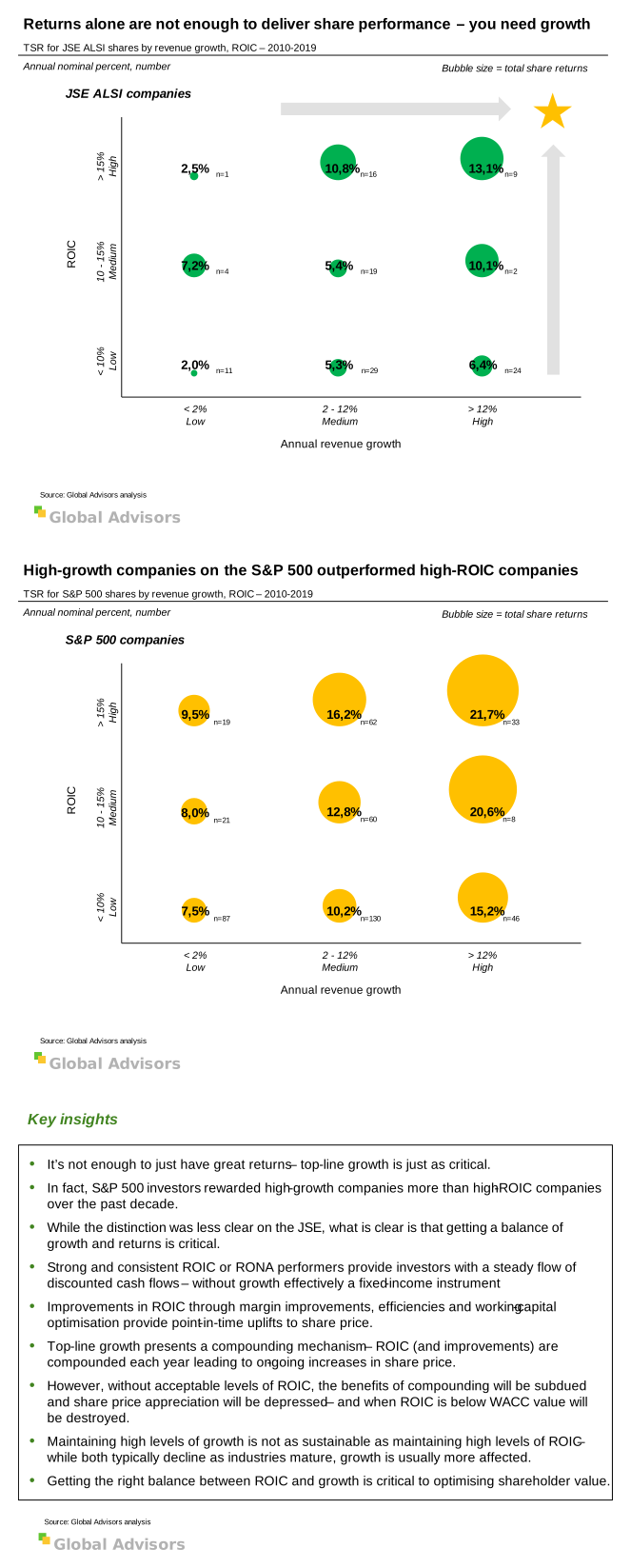
Fast Fact: Great returns aren’t enough
Key insights
It’s not enough to just have great returns – top-line growth is just as critical.
In fact, S&P 500 investors rewarded high-growth companies more than high-ROIC companies over the past decade.
While the distinction was less clear on the JSE, what is clear is that getting a balance of growth and returns is critical.
Strong and consistent ROIC or RONA performers provide investors with a steady flow of discounted cash flows – without growth effectively a fixed-income instrument.
Improvements in ROIC through margin improvements, efficiencies and working-capital optimisation provide point-in-time uplifts to share price.
Top-line growth presents a compounding mechanism – ROIC (and improvements) are compounded each year leading to on-going increases in share price.
However, without acceptable levels of ROIC, the benefits of compounding will be subdued and share price appreciation will be depressed – and when ROIC is below WACC value will be destroyed.
Maintaining high levels of growth is not as sustainable as maintaining high levels of ROIC – while both typically decline as industries mature, growth is usually more affected.
Getting the right balance between ROIC and growth is critical to optimising shareholder value.
Selected News

Quote: William Makepeace Thackeray – English novelist
The world is a looking-glass, and gives back to every man the reflection of his own face. Frown at it, and it will in turn look sourly upon you; laugh at it and with it, and it is a jolly kind companion; and so let all young persons take their choice. – William Makepeace Thackeray – English novelist
The Quote
Context of the Quote
This passage appears in William Makepeace Thackeray’s seminal novel Vanity Fair: A Novel Without a Hero (serialized 1847–1848), during a narrative reflection on human behavior and perception13. It occurs amid commentary on a young character’s misanthropic outlook, where the narrator observes that people who view the world harshly often receive harshness in return, attributing this to self-projection rather than external reality3. The metaphor of the world as a “looking-glass” (an old term for mirror) underscores the novel’s core theme of vanity—how personal attitudes shape social interactions in a superficial, reciprocal society13. Thackeray uses it to advise youth to choose optimism, contrasting it with the book’s satirical portrayal of ambition, deceit, and social climbing in early 19th-century England3.
Backstory on William Makepeace Thackeray
William Makepeace Thackeray (1811–1863) was a prominent English novelist, satirist, and illustrator, often ranked alongside Charles Dickens as a Victorian literary giant1. Born in Calcutta, India, to British parents—his father a colonial administrator—he returned to England at age six after his father’s early death1. Educated at Charterhouse School and Cambridge University, Thackeray initially pursued law and art but turned to journalism and writing amid financial ruin from failed investments and his wife’s mental illness following childbirth1.
His breakthrough came with Vanity Fair, a panoramic satire of British society during the Napoleonic Wars, drawing from John Bunyan’s The Pilgrim’s Progress (where “Vanity Fair” symbolizes worldly temptation)13. Published anonymously as monthly installments, it sold widely for its witty narration, moral ambiguity, and critique of hypocrisy among the upper and aspiring middle classes1. Thackeray followed with successes like Pendennis (1848–1850), Henry Esmond (1852), and The Newcomes (1853–1855), blending humor, pathos, and realism1. A rival to Dickens, he lectured on English humorists and edited Cornhill Magazine, but personal struggles with debt, health (addiction to opium and alcohol), and family tragedy marked his life. He died at 52 from a ruptured aneurysm1.
Thackeray’s style—omniscient, ironic narration—mirrors the quote’s philosophy: life reflects one’s inner disposition, a recurring motif in his works exposing human folly without heavy moralizing13.
Leading Theorists Related to the Subject Matter
The quote’s idea—that reality mirrors one’s attitude—echoes longstanding philosophical and psychological concepts on perception, projection, and optimism. Below is a backstory on key theorists whose ideas parallel or influenced this theme of reciprocal self-fulfilling prophecy.
-
Baruch Spinoza (1632–1677): Dutch philosopher whose Ethics (1677) posits that emotions like hope or fear shape how we interpret the world, creating self-reinforcing cycles. He argued humans project passions onto external events, much like Thackeray’s “looking-glass,” advocating rational optimism to alter perception[supplemental knowledge, aligned with Thackeray’s era].
-
Immanuel Kant (1724–1804): German idealist in Critique of Pure Reason (1781) who theorized that the mind imposes structure on sensory experience—our “face” colors reality. This subjective lens prefigures Thackeray’s mirror metaphor, influencing 19th-century Romantic views on personal agency in shaping fate.
-
William James (1842–1910): American pragmatist and psychologist, contemporary to Thackeray’s later influence, in The Principles of Psychology (1890) described the “self-fulfilling prophecy” where expectations elicit confirming behaviors from others. His optimism essays echo the quote’s call to “laugh at it,” linking mindset to social outcomes.
-
Norman Vincent Peale (1898–1993): 20th-century popularizer of positive thinking in The Power of Positive Thinking (1952), directly inverting frowns/smiles to transform life experiences—a modern extension of Thackeray’s advice, rooted in psychological projection.
-
Cognitive Behavioral Theorists (e.g., Aaron Beck, 1921–2021): Beck’s cognitive therapy (1960s onward) formalized cognitive distortions, where negative schemas (like frowning at the world) perpetuate sour outcomes, supported by empirical studies on attribution bias and reciprocity in social psychology.
These ideas trace from Enlightenment rationalism through Victorian literature to modern psychology, all converging on the insight that personal disposition acts as a filter and catalyst for worldly responses, as Thackeray insightfully captured13.
References
1. https://www.goodreads.com/author/quotes/3953.William_Makepeace_Thackeray
2. https://www.azquotes.com/author/14547-William_Makepeace_Thackeray
3. https://www.goodreads.com/work/quotes/1057468-vanity-fair-a-novel-without-a-hero
4. https://www.sparknotes.com/lit/vanity-fair/quotes/
5. https://www.coursehero.com/lit/Vanity-Fair/quotes/
6. http://www.freebooknotes.com/quotes/vanity-fair/
7. https://libquotes.com/william-makepeace-thackeray/works/vanity-fair
8. https://www.litcharts.com/lit/vanity-fair/quotes

Polls

What determines your success?
We need your help!
We’re testing how people think about their successes and failures. It would be great if you would take 2 minutes to give a simple multiple choice answer and share the poll with your friends.
Take the poll – “What determines your success?”
Then read So You Think You’re Self Aware?
Services
Global Advisors is different
We help clients to measurably improve strategic decision-making and the results they achieve through defining clearly prioritised choices, reducing uncertainty, winning hearts and minds and partnering to deliver.
Our difference is embodied in our team. Our values define us.
Corporate portfolio strategy
Define optimal business portfolios aligned with investor expectations
BUSINESS UNIT STRATEGY
Define how to win against competitors
Reach full potential
Understand your business’ core, reach full potential and grow into optimal adjacencies
Deal advisory
M&A, due diligence, deal structuring, balance sheet optimisation
Global Advisors Digital Data Analytics
14 years of quantitative and data science experience
An enabler to delivering quantified strategy and accelerated implementation
Digital enablement, acceleration and data science
Leading-edge data science and digital skills
Experts in large data processing, analytics and data visualisation
Developers of digital proof-of-concepts
An accelerator for Global Advisors and our clients
Join Global Advisors
We hire and grow amazing people
Consultants join our firm based on a fit with our values, culture and vision. They believe in and are excited by our differentiated approach. They realise that working on our clients’ most important projects is a privilege. While the problems we solve are strategic to clients, consultants recognise that solutions primarily require hard work – rigorous and thorough analysis, partnering with client team members to overcome political and emotional obstacles, and a large investment in knowledge development and self-growth.
Get In Touch
16th Floor, The Forum, 2 Maude Street, Sandton, Johannesburg, South Africa
+27114616371